
Most gardening advice you’ll find online was written for somewhere that isn’t here. Follow it in Arlington and you’ll plant tomatoes in April, watch them look magnificent in May, and give up in July convinced you don’t have a green thumb.
You do. The advice was just wrong for our climate.
Growing your own food in North Texas is genuinely rewarding and not particularly hard — but it runs on a different calendar than the one in the seed packet instructions, and the sooner you know that, the better your first season goes.
The single most important thing: we get two growing seasons
Not one. Two. And most people only ever plant the first.
Spring runs roughly March through June. Transplants go in after the last frost, typically around mid-March. This is your window for tomatoes, peppers, squash, cucumbers, and beans.
July and August are a gap, not a failure. Once night temperatures stay high, most vegetables simply stop setting fruit. The plants stay alive and look fine. They just don’t produce. Nothing you do changes this. Okra, southern peas, and sweet potatoes genuinely enjoy the heat; almost nothing else does.
Fall runs September through November, and it’s the better season. Greens, kale, chard, lettuce, spinach, broccoli, cabbage, carrots, beets, radishes, and garlic to overwinter. Cooler nights, far fewer pests, less watering, and a first frost that usually holds off until mid-to-late November.
Ask anyone who gardens seriously in Tarrant County which season they prefer and they’ll say fall. It’s the one nobody plants.
Why your tomatoes quit in July
This deserves its own answer because it’s the question we get most, and because people blame themselves for it.
Most tomato varieties stop setting fruit once nighttime temperatures stay above the mid-70s. The pollen becomes unviable. The plant keeps growing, keeps flowering, and sets nothing. It isn’t a watering problem, a fertilizer problem, or a soil problem.
The fix is timing, not technique. Get transplants in the ground early enough that they fruit before the heat arrives. Two weeks late in April costs you most of the harvest. And plan on a fall crop rather than expecting production straight through summer.
Raised beds, because you are not going to win against clay
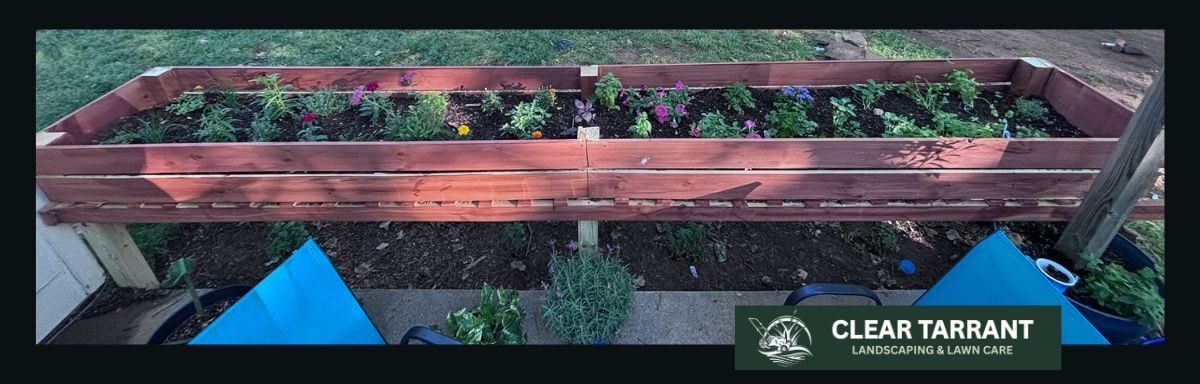
You can amend Arlington’s heavy clay over several years and slowly improve it. Or you can build a box, fill it with soil you chose, and grow food this season.
For vegetables specifically, the box wins nearly every time:
Drainage. Clay holds water, and vegetable roots sitting in saturated soil rot. After a wet North Texas spring that’s a real risk.
Control. Instead of fighting what’s there, you fill with a blend built for growing food — and it stays good, because nobody walks on it and compacts it.
Earlier warmth. Raised soil comes up to temperature faster in spring, which matters when your tomato window is as tight as ours.
Your back. Underrated. A bed you can work standing up is a bed that’s still being tended in year two.
Bermuda control. Bermuda grass will invade an in-ground vegetable patch relentlessly. A bed with a defined border is dramatically less work.
Cedar is worth the extra cost over treated lumber — it handles Texas weather without chemicals leaching into soil you’re growing food in.
More on raised beds and garden design →
Sun is the real constraint here
Not space. Most Arlington properties have plenty of room for a bed. What they often don’t have is enough unobstructed sun, because our neighborhoods are full of mature shade trees.
Most vegetables want six to eight hours of direct sun, and fruiting crops — tomatoes, peppers, squash — are the most demanding. Leafy greens and many herbs manage with less.
Before you build anything, spend a weekend watching where the light actually falls. Check at 9am, noon, and 4pm. The spot that seems obvious is often shaded for half the day by a live oak you’d stopped noticing.
If your whole backyard is shaded, greens and herbs are still very much on the table. Tomatoes aren’t, and no amount of optimism changes it.
Herbs: the highest return you’ll get
If you only plant one thing, make it a herb bed near the kitchen door.
Rosemary, thyme, oregano, and sage are effectively permanent here. They handle the heat, want little water once established, and come back year after year. Plant them once and they’re just there.
Chives and mint do well — though mint should be contained or it will take a bed over entirely.
Basil thrives in our summer heat but won’t survive a frost, so it gets replanted each spring. Worth it.
The economics are absurd in your favor. One rosemary plant costs less than three grocery store packets and produces for a decade.
Watering in a Texas summer
Two things people get wrong.
Containers dry out much faster than beds. A pot on a west-facing patio in August can need water twice a day. If you’re going to be away, containers are the wrong choice — go with an in-ground bed or a raised bed, which hold moisture far longer.
Deep and infrequent beats little and often. A proper soak that reaches the full root zone, then a gap, encourages roots to grow downward. Light daily sprinkling keeps roots at the surface, which is the worst possible place for them come July.
A soaker hose or drip line on a timer is the single best upgrade you can make to a vegetable garden here. And mulch the bed — two to three inches will cut your watering noticeably.
Plant flowers alongside the food
Squash, cucumbers, melons, and beans all need pollinators to set fruit. A vegetable bed with nothing flowering nearby is asking insects to find it by accident.
Native flowering plants solve this and cost you almost nothing in effort. North Texas sits on the monarch migration route, and natives feed both monarchs and the native bees that do most of the actual pollination work in a home garden.
Gregg’s mistflower, purple coneflower, autumn sage, and blackfoot daisy all thrive here and will draw insects to your beds. They also look considerably better than bare mulch.
A realistic first year
Don’t start with twelve crops. Start with one bed and four things you’ll actually eat.
Build in late summer, plant in September. Counterintuitive, but a fall garden is more forgiving, more productive, and far more likely to leave you wanting to do it again. Starting in spring means your first experience includes July.
Pick vegetables you buy anyway. Homegrown lettuce you don’t eat is just expensive compost.
Expect to lose something. Everyone does. It isn’t a verdict on you.
The gardens that survive to year three aren’t the ones with the most enthusiastic owners. They’re the ones where someone handles the unglamorous parts on schedule — pulling weeds before they seed, feeding the soil between plantings, and swapping the beds over from spring crops to fall crops at the right moment in September.
Want the garden without the upkeep?
We design and build cedar raised beds, plant them to the North Texas calendar, and can maintain them for you — weeding, feeding, and swapping the beds between spring and fall crops. You do the harvesting. Estimates are free.