
Arlington, Texas · Built For Clay Soil
Hardscaping & Patios in Arlington, TX
Flagstone patios, walkways, and stone borders built on a base that accounts for what North Texas clay does underneath them.
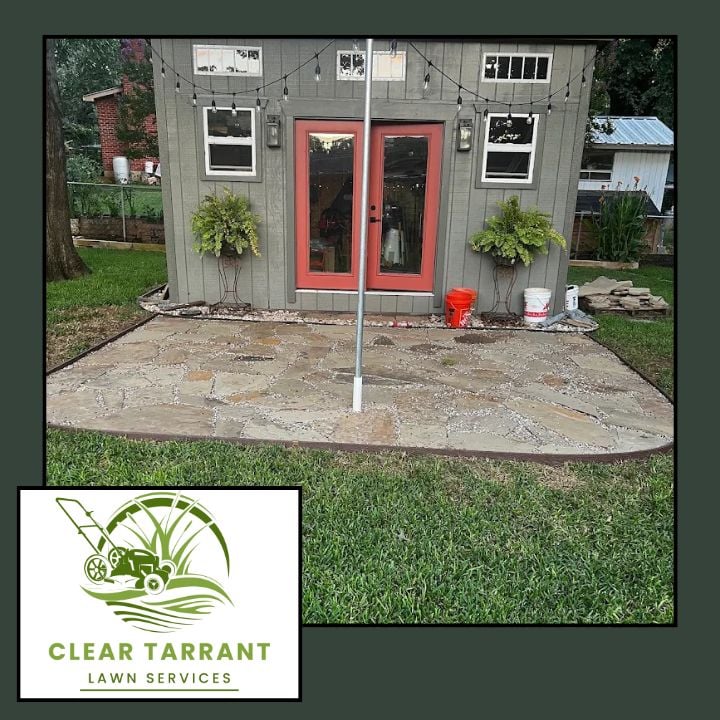
Flagstone patio · Arlington, TX
Fully Insured
Free Estimates
Proper Base Prep
Drainage Planned First
Clear Tarrant designs and builds hardscaping in Arlington, Texas and the surrounding Tarrant County communities. Work includes flagstone patios, stone and paver walkways, decomposed granite paths and seating areas, stone bed borders and edging, steps, and fire pit areas. Every installation is built on a compacted base with drainage planned before any stone is set, because North Texas expansive clay moves seasonally and hardscape built directly on native soil will not stay level. Estimates are free.
What We Build
Stone that turns unused yard into somewhere you sit
Most backyards have an area nobody uses — too muddy, too uneven, no reason to walk there. Hardscape is usually what fixes that.
Flagstone Patios
Natural stone laid on a prepared base, with joints filled to allow drainage and seasonal movement. Irregular flagstone for an organic look, or cut stone for a more formal pattern.
Walkways & Paths
From the driveway to the front door, around to the gate, or out to the shed. Usually solves a worn dirt track people have already made by walking the same line for years.
Stone Borders & Edging
Clean permanent lines between bed and lawn. Keeps mulch where you put it, keeps Bermuda out of your beds, and makes everything read as deliberate.
Decomposed Granite Areas
A well-compacted DG seating area or path costs considerably less than stone, drains beautifully, and suits a native or informal landscape. An underused option here.
Steps & Low Walls
Short runs of steps and low seating or bed walls where the yard changes level. Taller structural retaining walls are a different job — ask and we’ll be straight about scope.
Fire Pit Areas
A stone surround and a paved area around it, sited with clearance from structures, fences, and overhanging limbs. The thing that gets a backyard used in November.
North Texas Specific
The ground under your patio moves several inches a year
There’s a reason the Dallas–Fort Worth area supports an entire foundation repair industry. The clay under us is expansive — it swells when it takes on water and shrinks when it dries out, and in a climate that alternates between weeks of rain and two months without any, it does both every year.
That’s what cracks driveways. It’s what tilts poured concrete patios away from level. It’s why the slab someone poured in your backyard in 2019 now has a fault line across it and pools water in the low corner.
Two things follow from it, and they shape how we build:
The base matters more than the stone. Hardscape set straight onto native clay will ride every seasonal cycle the soil goes through. Excavating to proper depth, laying and compacting base material in lifts, and screeding a setting bed is the unglamorous majority of the work, and it’s the entire difference between a patio that’s level in ten years and one that isn’t.
Flexible beats rigid here. Flagstone and pavers on a compacted base move a little with the soil and stay intact — and if a section ever does settle, individual stones can be lifted and reset. A monolithic concrete slab has one option when the ground shifts underneath it, and that option is to crack.
Before Any Stone Gets Set
Where is the water going to go?
This is the first question we ask on a hardscape walkthrough, and it’s the one most quotes skip entirely.
You’re about to cover a section of yard with a surface that no longer absorbs rain. Every gallon that used to soak into that ground now has to go somewhere else. Get it wrong and you’ve built a very attractive way to route stormwater toward your foundation — which in expansive clay is the most expensive mistake available in a backyard.
So the surface pitches away from the house. A slope you’d never notice walking on it, but enough that water leaves rather than sits. Every patio, every walkway, no exceptions.
Joints and materials that drain. Permeable joint fill and compacted DG let water through rather than sheeting it off toward wherever the grade sends it.
And we look at what’s already happening. Where does your yard hold water after a storm? Where do your downspouts discharge? If there’s an existing drainage problem, building over it makes it worse, so we’d rather deal with it first than pretend it isn’t there.
If the honest answer is that your yard needs drainage work before it needs a patio, we’ll tell you that.
How We Work
From an idea to somewhere you sit
1. Walk it together
Where the sun and shade fall through the day, where water runs, how you’d actually use the space, and how big it needs to be for the furniture you have in mind.
2. Layout and materials
Shape and size marked out on the ground so you can stand in it before committing. Stone options with real prices, not a menu of upgrades.
3. Excavate and base
Dig to depth, haul the spoil off, lay and compact base in lifts, set the pitch for drainage, screed the setting bed. Most of the job happens here.
4. Set, fill, clean up
Stone laid and fitted, joints filled, edges restored, and every bit of spoil and offcut hauled away. You get a finished space, not a work site.
★★★★★ 5.0 on Google
What Arlington homeowners say
Clear Tarrant is our go-to for landscaping services, whether we need our lawn mowed or a project done that we do not have time to complete. They recently put in a flagstone patio for us. Sean listened, made suggestions and in the end we were very happy with the end result.
— Jerry W.
Sean was amazing from the very beginning of my project. His communication and how polite he was is the reason I had him come to my house. He will be my go-to for all my landscaping projects. His price was very reasonable.
— Lynda G.
Sean was amazing to work with and communication throughout was excellent. He takes pride in his work down to the smallest detail. The finished product surpassed my expectation.
— Michelle F.
Questions We Get
Hardscaping FAQs
How much does a flagstone patio cost in Arlington?
Patios are priced per project, because the variables are large: square footage, stone selection, how much excavation and base material the site needs, whether there’s a grade or drainage issue to correct, and access for hauling material in and spoil out. We measure, walk the site, and give you a free written estimate before anything begins.
Flagstone or concrete — which is better in North Texas?
For most residential patios here, flagstone or pavers on a properly compacted base outperform a poured slab. Our expansive clay swells and shrinks with moisture through the year, and a rigid slab has only one way to respond to that movement, which is to crack. Set stone flexes with the ground, and individual pieces can be lifted and reset if a section ever settles. Concrete still has its place, but it’s not the default answer it’s often treated as.
Why do patios crack and go uneven around here?
Almost always inadequate base preparation combined with expansive clay. Hardscape set on native soil without excavation and compacted base rides every seasonal swell and shrink the clay goes through. Poor drainage accelerates it — water pooling under or beside a patio makes the soil movement worse. The base is the part you never see and the part that determines whether it lasts.
Do I need a permit for a patio in Arlington?
Requirements vary by city and by what’s being built — ground-level patios are generally treated differently from structures, walls above a certain height, or anything involving electrical. We’ll tell you what we understand applies to your project, and we’d always recommend confirming with the City of Arlington directly before work starts.
How long does a patio take to build?
Most residential patios are a matter of days rather than weeks, with the bulk of the time going into excavation and base work rather than setting stone. Weather matters — you can’t compact a base properly in saturated clay, so a wet week pushes the schedule. We’ll give you a realistic window when we quote it.
Can you build a retaining wall?
We build low walls — seating walls, bed walls, and short runs where the yard changes level. Taller structural retaining walls holding back significant grade are a different category of work, often with engineering and permitting requirements, and we’ll tell you honestly if your project falls there rather than take it on.
Will a patio cause drainage problems?
It can, if it’s built without thinking about it — you’re replacing absorbent ground with a surface that sheds water. Done properly, the surface pitches away from the house and the joints and materials allow drainage. We look at where water currently goes on your property before we plan anything, and if there’s an existing drainage problem we’d rather address it than build over it.
Do you haul away the dirt and debris?
Yes, and it’s included. Excavated soil, offcuts, and packaging all leave with us. You get a finished space rather than a pile of spoil to deal with.
What areas do you serve?
Clear Tarrant is based in Arlington, Texas, and serves Tarrant County — including Mansfield, Kennedale, Grand Prairie, Pantego, Dalworthington Gardens, and southeast Fort Worth. If you’re not sure whether you’re in range, call and we’ll tell you straight.
Often Paired With Hardscape
Other services
Free Estimate
Show us the space
Text a photo of the area you have in mind, or call Sean and we’ll come walk it with you. Free estimate, and we’ll be straight about what the site actually needs.
Fully insured · Free estimates · Everything hauled away · Serving Arlington & Tarrant County