
Arlington, Texas · Curb Appeal That Lasts
Landscaping Installs & Design in Arlington, TX
Custom beds, plantings, and front-of-house transformations designed around your actual property — its light, its soil, and what it’ll look like in ten years, not just on install day.
Bed rebuild · Arlington, TX
Native Plant Society of Texas Certified
Fully Insured
Free Estimates
Everything Hauled Away
Clear Tarrant designs and installs residential landscaping in Arlington, Texas and the surrounding Tarrant County communities. Work includes front-of-house and foundation bed design, whole-yard planting plans, replacement of overgrown builder landscaping, bed shaping and edging, tree and shrub installation, mulch, and coordination with hardscape and irrigation. Plant selection accounts for mature size, sun exposure, and North Texas clay soil, and Clear Tarrant is certified by the Native Plant Society of Texas. Estimates are free.
You’ve Seen It On Every House
The builder put the same five plants in front of every home on your street
Walk any Arlington neighborhood built in the last forty years and you’ll see the identical foundation planting repeated house after house: a row of shrubs against the brick, something round at each corner, a crape myrtle, and mulch. It looked fine in year one. That was the point — it had to look fine long enough to sell the house.
Twenty years on, the problems are predictable and they’re everywhere:
The shrubs are eating the windows. They were installed at eighteen inches and their mature size is six feet. Now they’re pruned into blocks twice a year to keep them below the sill, which is a permanent maintenance tax paid because of a decision someone made in one afternoon.
They’re planted too close to the house. Tight against the brick, where there’s no room for the plant, no airflow, and beds that either stay bone dry under the eave or hold water against the foundation.
Nothing accounts for exposure. The same plant list went on the shaded north side and the west-facing wall that takes four hours of full August sun. One side thrives, the other has been struggling for two decades.
Replacing that is one of the most satisfying jobs we do. It’s usually a single project, it transforms the front of a house more than any other spend of similar size, and it ends the pruning treadmill for good.
What We Design & Install
From one bed to the whole front of the house
Front-of-House & Foundation Beds
The beds people actually see. Reshaped, replanted, and sized so nothing needs shearing to stay under a window. The single biggest visual change available on most properties.
Full Landscape Plans
Front, back, and side yards planned together so the property reads as one thing. Can be installed in phases if you’d rather spread the cost across seasons.
Tear-Out & Replant
Removing overgrown or failed plantings, correcting soil and grade, and starting properly. Everything that comes out leaves on the trailer.
Bed Shaping & Edging
Bed lines are what separate a designed yard from a planted one. Generous curves, clean edges, and a permanent border so Bermuda stays out.
Tree & Shrub Installation
Planted at the right depth, in the right spot, with mature size and utility lines accounted for. Most planting failures here trace back to depth and placement.
Pre-Sale Curb Appeal
Focused work on what shows in the listing photo and the drive-up. Fast, targeted, and aimed at the first eight seconds a buyer spends on your house.
Real Work · Arlington, TX
Failing foundation beds, rebuilt
Both of these are the same property. Weedy, patchy beds against the house — the kind that get replanted every year and fail every year — cleared, re-cut with steel edging, and rebuilt with river rock and ornamental grasses.
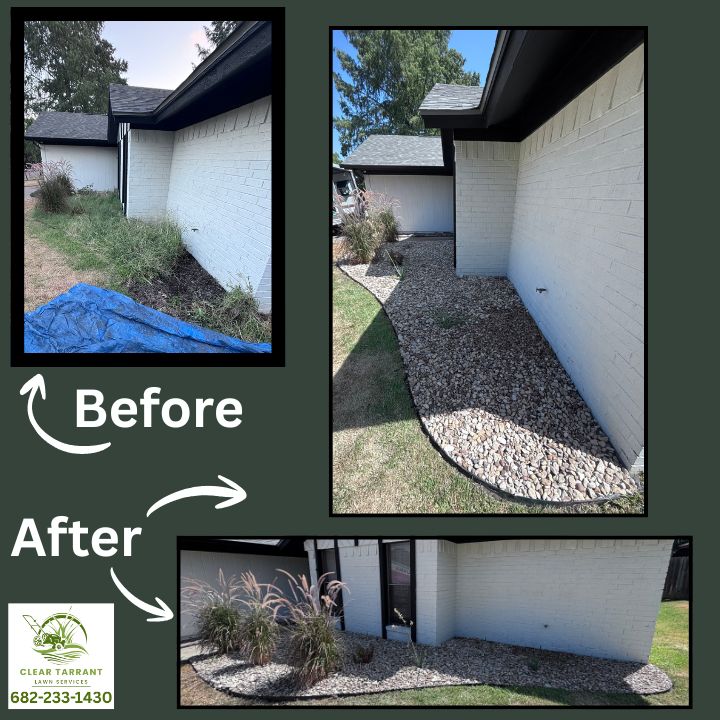
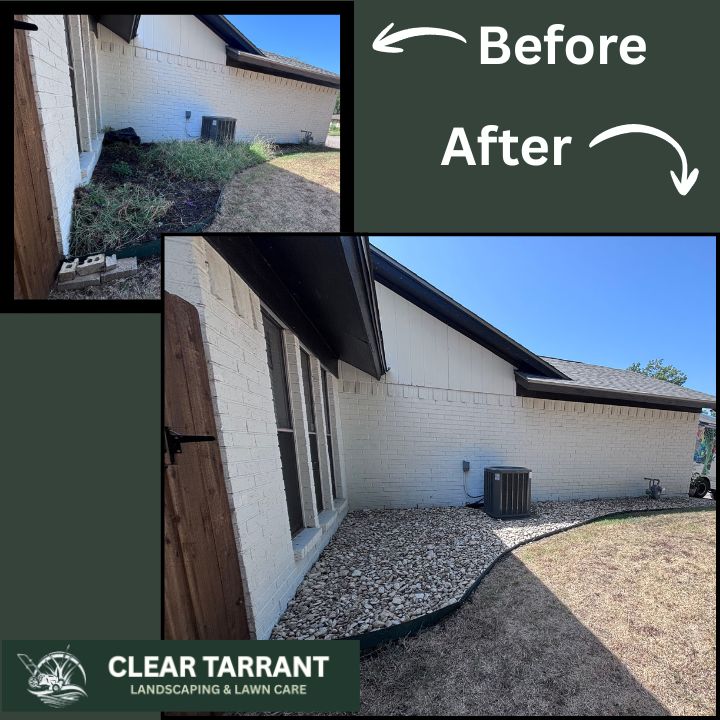
The bed line is the part most people notice without naming it. A generous, deliberate curve cut with a permanent edge reads as designed. A ragged line where grass has crept in over the years reads as neglected — regardless of what’s planted in it.
Why rock made sense here
The homeowner wanted rock, and this was a case where it was also the right material. That wall faces west — it takes hours of direct afternoon sun and radiates heat back into the bed well after sundown. It’s the harshest exposure on any Arlington house, and it defeats a lot of what gets planted against it.
Where we’d steer you differently: rock sheds water rather than absorbing it, and it never breaks down into the soil the way natural mulch does. Against a foundation, that only works if the grade carries water away from the house. On a bed that already holds water, or where you want the soil improving year over year, mulch is the better answer — and we’ll say so.
How We Design
Four things that separate a designed bed from a planted one
Plan for mature size, not nursery size
Everything in a pot is small. The question is what it becomes in eight years. Spacing for mature size means a bed looks slightly sparse the first season and correct forever after — instead of full immediately and overcrowded by year four. This is the mistake behind most of the shrubs currently swallowing windows in your neighborhood.
Evergreen bones first, color second
A bed made entirely of flowering perennials is spectacular in May and empty in January. Structure goes in first — evergreen shrubs and grasses that hold the shape year-round — and seasonal color layers on top of that skeleton. Then the bed still reads as intentional in February.
Repetition, not a collection
One of everything reads as chaos. Groups of three, five, or seven of the same plant, repeated down a bed, read as deliberate. It’s the difference between a garden center haul and a design — and it’s the change most homeowners notice immediately without being able to name it.
Every wall of your house is a different climate
A west-facing wall in Arlington takes hours of afternoon sun and radiates heat back into the bed well after sunset. It is a genuinely harsher environment than the north side of the same house, thirty feet away. Same plant list on both sides is why one bed has always thrived and the other has never worked.
North Texas Specific
Beds against the house are not just decoration here
North Texas sits on expansive clay — soil that swells when wet and shrinks when dry. It’s the reason this region supports an entire foundation repair industry, and it means the planting beds along your foundation are doing more than looking nice.
Consistency matters more than quantity. Soil that stays evenly moist moves less than soil that swings between saturated and bone dry. Beds under a wide eave often stay dry through a rainy week; beds where a downspout dumps stay soaked. Both extremes are worth correcting, and often the fix is grading and drainage rather than plants.
Big trees close to the house draw a lot of water. A mature shade tree can pull serious moisture out of the ground within its root zone. That’s a real consideration in where new trees go, and it’s why we plan placement with the structure in mind rather than just the view.
Grade should carry water away. Beds that sit higher than the surrounding ground, or that trap water against the brick, are working against you. We look at where water goes before deciding where anything gets planted.
To be clear about scope: we’re landscapers, not foundation contractors. If you’re seeing cracks, sticking doors, or movement, that’s a conversation for a foundation specialist — and we’ll say so rather than imply that a planting plan fixes it. What we can do is make sure your landscape isn’t contributing to the problem.
How We Work
From walkthrough to planted
1. Walk it together
Sun through the day, where water runs after a storm, soil condition, what’s worth keeping, and how much upkeep you actually want to sign up for.
2. Plan and quote
Bed lines marked on the ground so you can see the shape before committing. Specific plants, specific placement, a real number. Free either way.
3. Clear and prep
Old plantings out and off the property, beds cut and shaped, soil amended where clay needs it, grade corrected where water is going the wrong way.
4. Plant, mulch, clean up
Planted at correct depth and spacing, mulched, edges cut clean, and every scrap hauled off. Plus straight guidance on watering through the first season.
Fall and early spring are the best planting windows in North Texas. Planting in July means fighting to keep new roots alive through the worst of the year. If you call us midsummer we’ll often recommend planning now and installing in October — it costs a few months and saves the plants.
★★★★★ 5.0 on Google
What Arlington homeowners say
I was looking for some landscaping work that I needed done at my house and came across Clear Tarrant. Sean was amazing from the very beginning of my project. He will be my go-to for all my landscaping projects. My backyard looked great when he was finished.
— Lynda G.
Clear Tarrant is our go-to for landscaping services. They recently put in a flagstone patio for us. Sean listened, made suggestions and in the end we were very happy with the end result.
— Jerry W.
Sean was amazing to work with and communication throughout was excellent. He takes pride in his work down to the smallest detail. The finished product surpassed my expectation.
— Michelle F.
Questions We Get
Landscape design FAQs
How much does landscaping cost in Arlington?
It’s priced per project, because the range is wide — refreshing a single foundation bed and replanting the entire front of a house are different orders of magnitude. Cost is driven by area, how much removal and soil prep is needed, plant sizes at install, whether grading or drainage work is required, and any hardscape involved. We walk the property and give you a free written estimate with specific plants and placement, not a vague range.
Can I do the work in phases?
Yes, and plenty of people do. We can plan the whole property and then install in stages across seasons so the cost spreads out. The advantage of planning it all at once is that each phase fits the others instead of looking like three separate decisions made years apart.
When is the best time to plant in North Texas?
Fall is the best window, with early spring a close second. Fall planting gives roots a long cool season to establish before summer arrives. Planting in July means fighting to keep new roots alive through the worst of the year, so if you’re calling midsummer we’ll often recommend planning now and installing in October.
Why do the shrubs in front of my house always outgrow the windows?
Because they were selected for how they looked at install rather than for mature size. Builder landscaping is planted small and sold quickly, and the plants commonly used reach five or six feet at maturity under a three-foot window. The result is shearing them into blocks twice a year forever. Replacing them with plants whose mature size actually fits the space ends that permanently.
Do you use native plants?
Wherever they fit, yes. Clear Tarrant is certified by the Native Plant Society of Texas, and natives handle Arlington’s clay, heat, and watering restrictions with far less input. That said, a design isn’t required to be all native — well-adapted non-natives have their place, and we’ll build around what you want the yard to look like.
Will landscaping near my foundation cause problems?
It can help or hurt depending on how it’s done. North Texas expansive clay moves as moisture changes, so consistent soil moisture around a foundation is better than swinging between saturated and bone dry. Beds that trap water against the brick, downspouts discharging into a bed, and large trees placed close to the structure are all worth thinking through. We plan with that in mind. If you’re already seeing cracks or doors sticking, that’s a foundation specialist’s call, not ours.
Do you remove the old landscaping?
Yes, and it’s included. Old shrubs, failed plantings, dead material, and old mulch come out and leave on the trailer. You get a finished bed rather than a pile of root balls to deal with.
I’m selling my house. What gives the best return?
The front of the house, focused on what appears in the listing photo and the walk from the driveway to the door. Clean bed lines, fresh mulch, healthy plants at a sensible scale, and nothing overgrown blocking windows. It’s usually a fast, targeted project rather than a full redesign, and it’s among the cheapest improvements per dollar of impression.
What areas do you serve?
Clear Tarrant is based in Arlington, Texas, and serves Tarrant County — including Mansfield, Kennedale, Grand Prairie, Pantego, Dalworthington Gardens, and southeast Fort Worth. If you’re not sure whether you’re in range, call and we’ll tell you straight.
Often Part Of The Same Project
Other services
Free Estimate
Send us a photo of the front of your house
Text a picture or call Sean. We’ll walk the property, mark out bed lines so you can see the shape, and put together a plan with real plants and a real number.
Fully insured · Free estimates · Everything hauled away · Serving Arlington & Tarrant County